News & Blog
What is the difference between round link sprockets and roller chain sprockets?
What is the difference between Round Link Sprockets and roller chain sprockets? If you’re sourcing drive components for a cement plant, a lumber conveyor, or a heavy-duty elevator, this question isn’t academic—it’s the decision between a line stoppage and months of smooth operation. A round link sprocket engages with welded steel chain links, thriving in low-speed, abrasive environments where gritty dust buries anything precise. A roller chain sprocket meshes with precision bushings and rollers, delivering higher speed, smoother motion, and easier maintenance. Making the wrong choice often means accelerated wear, unexpected downtime, and a scramble for replacements. At Raydafon Technology Group Co.,Limited, we’ve guided hundreds of procurement professionals past this exact crossroad. This article breaks down the differences in design, performance, and real-world scenarios so you can select the right sprocket with confidence—and keep your operations running.
- 1. What Are Round Link Sprockets?
- 2. What Are Roller Chain Sprockets?
- 3. Key Differences Between Round Link and Roller Chain Sprockets
- 4. Common Pain Points in Sprocket Selection and How to Solve Them
- 5. When to Choose Round Link Sprockets vs Roller Chain Sprockets
- 6. Frequently Asked Questions
- 7. How Raydafon Technology Group Co.,Limited Solves Your Sprocket Challenges
- 8. References
What Are Round Link Sprockets?
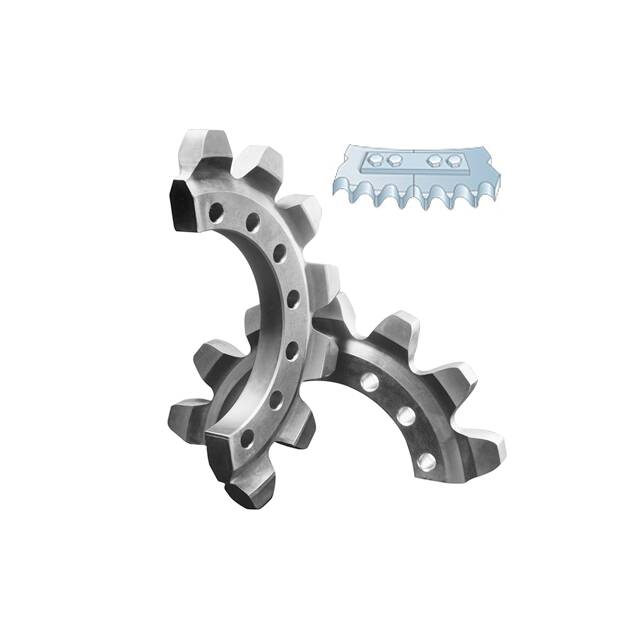
Round link sprockets are designed to engage with round link chains—chains composed of interconnected oval or circular steel links, often used in lifting, dragging, and heavy conveying applications. You’ll see them in mining conveyors, flight bars on waste treatment screens, bucket elevators in grain silos, and ship unloaders. The sprocket teeth are cast or machined with deep pockets that cradle the chain links, allowing the drive to transmit force even when covered in mud, ore dust, or wet wood chips.
Their greatest strength is forgiveness. A round link chain can stretch slightly, handle misalignment, and endure impact loads that would snap a precision roller chain. This makes round link sprockets a go-to in harsh environments where maintenance access is limited and contamination is inevitable. However, because the links slide and pivot against each other and the sprocket pocket without precision rollers, friction is higher, speed is limited, and energy efficiency drops. If your operation prioritizes toughness over speed, round link sprockets might be the right answer.
What Are Roller Chain Sprockets?
Roller chain sprockets pair with roller chains—a series of interconnected links, each containing a bushing and a free-rotating roller. This engineered roller reduces friction as it engages with the sprocket tooth, making the drive smoother, quieter, and capable of higher speeds. Industries from automotive assembly lines to packaging machinery and bicycle drivetrains rely on roller chain sprockets for precise timing and efficient power transmission.
The precision of roller chain sprockets is both a blessing and a demand. They require proper lubrication, alignment, and protection from contamination. Dirt between the roller and sprocket can cause rapid wear, while misalignment leads to uneven loading and chain stretch. Yet when these conditions are met, roller chain sprockets deliver higher horsepower per weight, reduced noise, and long service life. For procurement specialists, the decision often hinges on whether the operating environment can support such precision—and what happens when it can’t.
Key Differences Between Round Link and Roller Chain Sprockets
The question “What is the difference between round link sprockets and roller chain sprockets?” isn't only about appearance. It’s about how they handle force, speed, environment, and cost. The table below summarizes the critical engineering contrasts that directly impact your sourcing decisions.
| Characteristic | Round Link Sprockets | Roller Chain Sprockets |
|---|---|---|
| Chain engagement | Link pockets cradle chain links; sliding contact | Teeth mesh with rollers; rolling contact |
| Speed capability | Low to moderate, typically below 1 m/s | Moderate to high, up to 20 m/s or more |
| Environmental tolerance | Excellent—handles dust, moisture, grit | Poor without sealing/lubrication; sensitive to contamination |
| Wear resistance | Good under impact, but friction wear is higher | Excellent when lubricated and aligned |
| Shock load capacity | High—chain can stretch and absorb impact | Limited—shock can damage rollers and sprocket teeth |
| Maintenance needs | Minimal—often runs dry | Regular lubrication, alignment checks required |
| Typical cost (per kW transmitted) | Higher initial cost, lower maintenance cost | Lower initial cost, higher long-term maintenance |
Understanding what is the difference between round link sprockets and roller chain sprockets at this level helps you move beyond catalog specs and into real performance economics. For example, a roller chain sprocket might seem cheaper upfront, but if your application exposes it to wet ash or sand, the replacement frequency will erase any savings. On the other hand, a round link sprocket in a clean, high-speed line would waste energy and generate noise.
Common Pain Points in Sprocket Selection and How to Solve Them
Scenario 1: A cement mill drag chain keeps breaking.
The maintenance team replaces roller chain sprockets every four weeks because cement dust grinds into the bushings. The real issue isn’t the sprocket quality—it’s the mismatch between the precision roller chain and the abrasive environment. Switching to a round link sprocket with an engineered chain eliminates the bushing failure point, extending service intervals to six months or more. Raydafon Technology Group Co.,Limited often advises customers in mining and cement to adopt this switch when abrasive contamination is the primary wear driver.
Scenario 2: High-speed labeling machine experiences timing drift.
Here, a round link sprocket was substituted temporarily but could not maintain the required timing accuracy. The round link’s inherent slack and sliding engagement caused cumulative index errors. The solution was a precision roller chain sprocket with hardened teeth and an automatic lubrication system, restoring synchronization to within ±0.1 mm. For such scenarios, our team at Raydafon Technology Group Co.,Limited provides tooth profile optimization to match exact indexing demands.
In both cases, the pain stemmed not from a bad component, but from applying the wrong sprocket type for the conditions. A thorough review of operating parameters—speed, load, environment, and alignment—must guide your selection.
When to Choose Round Link Sprockets vs Roller Chain Sprockets
Choose round link sprockets when your application involves:
- Heavy shock loads (rock crushers, ship unloaders)
- Severe contamination (cement, foundries, grain dust)
- Limited maintenance access (underground mining conveyors)
- Slow speeds and high torque (winches, scraper conveyors)
Choose roller chain sprockets when the priority is:
- High-speed operation (packaging lines, textile machinery)
- Precision timing (printing presses, robotics joints)
- Reduced noise and vibration (automotive engine cam drives)
- Ease of replacement using standard off-the-shelf components
Raydafon Technology Group Co.,Limited helps procurement professionals weigh these factors by offering both round link and roller chain sprockets manufactured to ISO, DIN, and ANSI standards. Our engineering support ensures you don't just buy a part—you invest in a solution matched to your operating reality.
Frequently Asked Questions
What is the difference between round link sprockets and roller chain sprockets in terms of load distribution?
Round link sprockets distribute load across the entire chain link pocket, making them more tolerant of uneven loading and impact. Roller chain sprockets concentrate load on each roller-to-tooth contact, which delivers higher precision but demands uniform loading to avoid premature wear.
Can I use a round link sprocket with a roller chain, or vice versa?
No. Round link sprockets are designed exclusively for round link chains, and roller chain sprockets only match roller chains. The tooth profiles and pitch dimensions are incompatible. Attempting to mix them leads to immediate failure, jamming, or safety hazards. Always confirm chain type and sprocket specification with your supplier. Raydafon Technology Group Co.,Limited provides full traceability and technical datasheets to prevent costly mismatches.
How Raydafon Technology Group Co.,Limited Solves Your Sprocket Challenges
For two decades, Raydafon Technology Group Co.,Limited has been a trusted partner for procurement teams across 40 countries. We manufacture both round link sprockets and precision roller chain sprockets in our ISO 9001-certified facilities, with options in induction-hardened steel, stainless steel, and engineered polymers. Beyond products, we deliver value through application engineering: selecting the correct pitch, tooth count, bore design, and heat treatment so your drive system runs longer and costs less per operating hour. When you're asking "What is the difference between round link sprockets and roller chain sprockets?" we don’t just give you a spec sheet—we audit your conditions and recommend a configuration that will survive them.
Our rapid prototyping service can turn around custom sprockets in 15 days, and our global logistics ensure on-time delivery whether you're headquartered in Houston, Hamburg, or Hanoi. With Raydafon Technology Group Co.,Limited, you aren’t just buying components; you’re gaining a dedicated engineering team that treats your downtime as an emergency and your performance targets as our own.
Have a specific challenge or need a sprocket recommendation? Contact us today. Our technical team at Raydafon Technology Group Co.,Limited is ready to walk through your specifications and provide a tailored quote. Reach out at [email protected] or visit www.raydafon-couplings.com to explore our full range of power transmission solutions. Let’s engineer reliability into your next project.
References
Zhang, L., & Chen, Y., 2022. Wear mechanisms of round link chains in abrasive environments. Tribology International, 168, 107439.
Miller, R. J., 2019. Fatigue life prediction of welded round link chains using multiaxial criteria. Engineering Failure Analysis, 101, 152-166.
American Chain Association, 2020. Standard Handbook of Chains: Chains for Power Transmission and Material Handling (2nd ed.). CRC Press.
Pereira, A., et al., 2021. Comparative study on roller chain drive efficiency under misalignment. Mechanism and Machine Theory, 155, 104076.
Bauer, G., 2018. Design optimization of sprocket tooth profiles for roller chains to reduce polygon effects. Journal of Mechanical Design, 140(6), 063301.
Kumar, S., & Patel, D., 2020. Influence of pitch variation on dynamic behavior of roller chain drives. International Journal of Mechanical Sciences, 183, 105799.
ISO 606:2015. Short-pitch transmission precision roller and bush chains, attachments and associated chain sprockets. International Organization for Standardization.
DIN 22252:2012. Round steel link chains, chain connectors and associated chain sprockets for mining. Deutsches Institut für Normung.
Lee, H. S., & Kim, T. W., 2023. Lifecycle cost analysis of round link versus roller chain systems in cement conveying. International Journal of Precision Engineering and Manufacturing, 24(4), 872-881.
Johnson, K. L., 2017. Contact mechanics of chain-sprocket interactions: a review. Wear, 376-377, 1233-1245.
Related News
- What is the difference between a split bush and a solid bush?
- What is the maximum horsepower rating for a PTO speed reducer gearbox?
- How much land can a horse drawn plough till in a day?
- What is the maximum weight you can load on dumbbell discs?
- How do you select the right segmented sprocket for a mining conveyor?
- Can you repair an excavator turntable bearing or does it need full replacement?
Leave me a message