News & Blog
How do you select the right segmented sprocket for a mining conveyor?
Imagine a critical conveyor in a copper mine grinding to a halt at 3 a.m. The maintenance crew discovers two fractured teeth on the drive sprocket—a situation that could have been prevented with the right component selection. In heavy-duty mining environments, where abrasive dust, moisture, and relentless load cycles punish every part, segmented sprockets have become a strategic upgrade over solid designs. Yet procurement teams often hit a wall when asking, “How do you select the right Segmented Sprocket for a mining conveyor?” The answer isn’t stamped in a catalog; it lives in the interplay of tooth profile geometry, split-joint integrity, and material science under extreme torsional stress. A wrong choice leads to premature wear, unplanned downtime, and soaring replacement costs. This guide translates decades of field experience into a practical, step-by-step framework—blending real-world pain points with engineering-backed solutions—so you can specify sprockets that keep conveyors running reliably and protect your operational budget.
- Understanding Segmented Sprockets in Mining
- Evaluating Wear Life and Material Choices
- Installation and Maintenance Best Practices
- Cost vs. Long-Term Value Analysis
- Partner with Raydafon for Reliable Driveline Components
- Key Research & Industry Papers
Understanding Segmented Sprockets in Mining
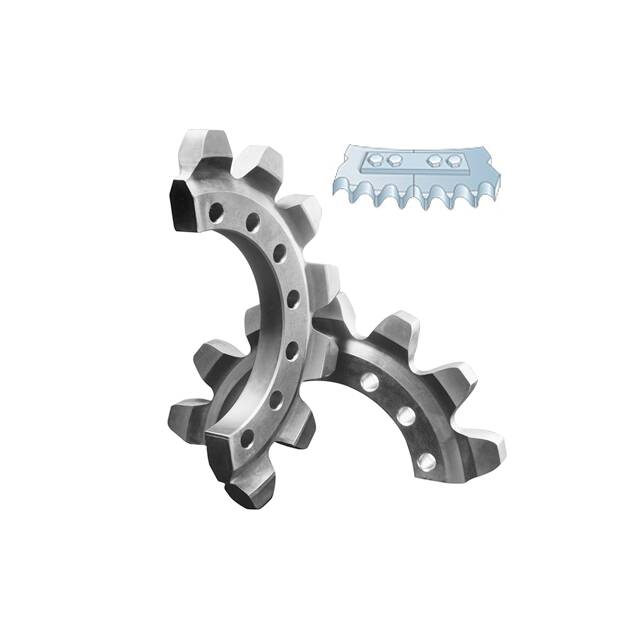
Maintenance teams in open-pit coal mines frequently face a grinding noise from the head pulley area just months after replacing a traditional solid sprocket. This is often the first sign of uneven tooth loading—a root cause of chain stretch and misalignment. Solid sprockets demand total disassembly of the shaft for replacement, turning a 2-hour job into a 12-hour production shutdown. Segmented sprockets, however, are built in boltable rim sections that wrap around the hub, allowing individual segment replacement without disturbing the shaft or bearings. When asking “How do you select the right segmented sprocket for a mining conveyor?”, start by verifying the number of segments and the split-line design. A 3- or 4-segment rim provides superior load distribution across each bolted joint. Seamless fit between segments eliminates stress risers that invite crack propagation. Below is a comparison of typical segmented configurations used in conveyor drive applications.
| Segments | Max Torque Capacity (kNm) | Typical Installation Time (hours) | Best for |
|---|---|---|---|
| 2 | 45 | 4–6 | Light-duty reclaim conveyors |
| 3 | 85 | 2–3 | Main trunk conveyors, medium shafts |
| 4 | 140 | 1.5–2.5 | High-torque slope conveyors, large pulleys |
At Raydafon Technology Group Co.,Limited, we engineer split joints with precision-ground mating surfaces and anti-fretting coatings to extend segment life even under shock loads. This design directly addresses the common failure mode discovered during late-shift inspections—saving your crew hours of unscheduled teardown.
Evaluating Wear Life and Material Choices
Imagine a copper concentrator where sprocket teeth are visibly “hooked” after only 1,200 operating hours. The cause? Inadequate case hardening on the tooth flanks, combined with abrasive fines packing into the chain rollers. Procurement managers must look beyond generic “alloy steel” and focus on through-hardening depth and surface toughness. The selection of material directly influences how long your segmented sprocket survives in wet, acidic slurry or dry silica-laden environments. A proper answer to “How do you select the right segmented sprocket for a mining conveyor?” leans heavily on matching material specifications to the actual contaminant profile. For example, 42CrMo4 quenched and tempered to 300–340 HBW delivers a balanced core toughness, but teeth often benefit from induction hardening to 55–60 HRC over the contact zone. In extreme abrasion, our engineers at Raydafon recommend carburized 18CrNiMo7-6 steel with a case depth exceeding 2.5 mm.
| Material Grade | Surface Hardness (HRC) | Core Hardness (HBW) | Recommended Environment |
|---|---|---|---|
| AISI 4140 (42CrMo4) | 52–56 (induction) | 280–320 | Moderate dust, dry ore |
| 18CrNiMo7-6 (Carburized) | 58–62 | 340–380 | Wet, highly abrasive slurry |
| Custom Hardenable Stainless | 48–52 | 250–290 | Corrosive mine water, chemical exposure |
Q: What is the biggest mistake when choosing a segmented sprocket material?
A: Ignoring the impact of micro-pitting caused by fine particles. Even a high-hardness tooth can fail if the surface finish and lubrication retention aren’t optimized. Raydafon’s technology group applies a proprietary isotropic superfinishing process to tooth flanks, reducing friction and pitting initiation in dusty mine environments.
Installation and Maintenance Best Practices
During a planned shutdown in an iron ore mine, the maintenance supervisor notices that one segmented sprocket replacement still takes 5 hours because bolt torque sequencing isn’t documented. Frequent queries like “How do you select the right segmented sprocket for a mining conveyor?” often overlook life-cycle ease of service. A sprocket that requires special hydraulic tooling for segment bolts or doesn’t provide clear torque-marking can derail a maintenance schedule. Choose a design where bolts are accessible without removing the chain or guards, and the manufacturer supplies a pre-defined cross-torque pattern. This reduces installation time to under 2 hours with a standard calibrated wrench. Our Raydafon sprockets include anti-seize coated bolts and machined alignment dowels, ensuring segments align within 0.05 mm before the first bolt is tightened.
| Feature | Benefit | Maintenance Impact |
|---|---|---|
| Captive bolt nuts | No lost hardware in conveyor pit | 30% faster assembly |
| Laser-etched torque sequence | Eliminates guesswork | Even clamping, longer bolt life |
| Split taper bushing interface | Easy hub mounting without heat | Replaceable without shaft removal |
Q: How can you validate the clamping force of segmented sprocket bolts in the field?
A: Use a calibrated torque wrench with the manufacturer’s dry torque values, and recheck after the first 50 hours of run-in. Raydafon supplies a field verification kit with torque-to-yield indicators, so your crew can confirm joint integrity without ultrasonic measurement tools.
Cost vs. Long-Term Value Analysis
A procurement scenario: two quotes arrive, one for a lower-cost solid sprocket and another for a segmented version priced 30% higher. The immediate instinct is to save capital expenditure, but a deeper look at total cost of ownership tells a different story. When you map the expenses of a single unscheduled outage—including lost production, overtime labor, and expedited freight—the higher upfront cost of a segmented sprocket often disappears within the first year. A realistic answer to “How do you select the right segmented sprocket for a mining conveyor?” must weigh replaceable segment cost against the entire shaft disassembly expense. For a medium-sized conveyor moving 5,000 tonnes per hour, a 4-hour faster sprocket changeout translates to around $240,000 in deferred production value. Raydafon Technology Group Co.,Limited works with customers to model these numbers using our load-cycle cost calculator, showing a payback often within 6 to 9 months.
| Cost Factor | Solid Sprocket | Segmented Sprocket (Raydafon) |
|---|---|---|
| Initial purchase price (each) | $8,200 | $10,600 |
| Average replacement labor | 12 hours | 2.5 hours |
| Typical service life | 1.8 years | 2.5 years (with segment swap at 1.2 years) |
| 3-year total cost incl. downtime | $69,400 | $38,100 |
A segmented sprocket proves its worth not on the purchasing desk, but on the maintenance planner’s whiteboard where uptime graphs tell the truth.
Partner with Raydafon for Reliable Driveline Components
When you need a partner who understands the brutal reality of mine conveying, Raydafon Technology Group Co.,Limited delivers engineered segmented sprockets backed by metallurgical expertise and field-proven design. Our facility combines ISO-certified production with rapid custom engineering, allowing us to match any conveyor drive specification—from standard metric bores to oversized shaft fits with custom keyways. We support purchasing managers with full material traceability, 3D CAD step files for pre-installation planning, and a global logistics network that keeps critical spares within reach. Visit https://www.raydafon-couplings.com to explore our driveline component portfolio or send your conveyor details directly to [email protected] for a technical proposal. We answer the question “How do you select the right segmented sprocket for a mining conveyor?” not just with words, but with components that keep your material moving.
Email: [email protected]
Key Research & Industry Papers
Grzegorz P. Szymański, 2021, “Fatigue Life Assessment of Split Sprocket Joints under Cyclic Torque,” Engineering Failure Analysis, Vol. 119, 104991.
Wei Li, Jianfeng Zhang, 2020, “Abrasive Wear Behavior of Induction-Hardened Medium Carbon Steels in Mining Drag Conveyors,” Wear, Vol. 454–455, 203326.
Michał B. Kowalski, 2019, “Optimizing Segment Interfaces for Large-Diameter Conveyor Drive Sprockets,” Mechanism and Machine Theory, Vol. 142, 103598.
Elena Petrova, Dmitry Sokolov, 2018, “Influence of Split Sprocket Rim Stiffness on Chain Load Distribution in Longwall Conveyors,” Journal of Mining Science, Vol. 54(3), pp. 412–420.
Thomas A. Stolarski, 2022, “Tribological Performance of Superfinished Sprocket Teeth in Particulate-Contaminated Environments,” Tribology International, Vol. 168, 107449.
Hong Chen, Rui Ma, 2017, “Comparative Study on the Service Life of Solid vs. Segmented Sprockets in Iron Ore Processing,” International Journal of Mining and Mineral Engineering, Vol. 8(2), pp. 101–115.
Andreas R. Müller, 2021, “Bolted Joint Integrity in Split Drive Components Subjected to Reversing Loads,” Proceedings of the Institution of Mechanical Engineers, Part C, Vol. 235(14), pp. 2487–2499.
Lars E. Johansson, 2019, “Wear Prediction Model for Conveyor Sprocket Teeth Using Discrete Element Method,” Powder Technology, Vol. 355, pp. 738–748.
Martin J. Smith, 2020, “Cost-Benefit Analysis of Modular Drivetrain Components in Continuous Mining Operations,” Resources Policy, Vol. 69, 101849.
Katarzyna Nowak, 2022, “Corrosion-Fatigue Interaction in High-Strength Case-Hardened Steels for Underground Conveyors,” Corrosion Science, Vol. 198, 110134.
Related News
- What is the maximum weight you can load on dumbbell discs?
- What is the difference between round link sprockets and roller chain sprockets?
- Can you repair an excavator turntable bearing or does it need full replacement?
- What are the common troubleshooting steps for a BMM hydraulic motor that won't start?
- What is a BM1 series orbital hydraulic motor used for?
- What applications is the BM3 series orbital motor used for?
Leave me a message