News & Blog
How does a BM6 orbital hydraulic motor work?
If you’re sourcing hydraulic components for heavy machinery, you’ve likely asked yourself: How does a BM6 orbital hydraulic motor work? It’s a question that comes up when a compact drive needs to deliver high torque at low speed without the bulk of a gearbox. Imagine a skid-steer loader bogged down in wet clay. The wheels shudder, the engine strains, but the auxiliary drive—a BM6 motor—keeps the attachment spinning relentlessly. That dependability comes from a deceptively simple gerotor design that converts oil pressure into smooth rotary motion. In this guide, we’ll walk through the internal choreography of the BM6 motor so you can evaluate whether it solves your torque-density challenge. You’ll also see how Raydafon Technology Group Co.,Limited supplies BM6 motors that help procurement teams cut downtime and maintenance cost—without sacrificing performance.
BM6 Orbital Motor Fundamentals
Picture a maintenance supervisor staring at a failed conveyor drive at 6 a.m. The OEM replacement motor has a 12-week lead time. That’s a familiar pain point when you depend on a single-source component. A BM6 orbital motor fits a standard SAE mounting pattern and flows from readily available distributors, so you can swap it in the same shift. Its architecture revolves around a fixed-axis gerotor set—a free-spinning inner rotor with one fewer tooth than the outer ring—that creates expanding and contracting chambers. Pressurized oil enters through a spool valve, pushes the rotor, and exhausts on the opposite side. Because the rotor orbits inside the stator, output speed is proportional to flow rate, and torque is directly tied to pressure drop. The simplicity means fewer parts to wear, which answers the question How does a BM6 orbital hydraulic motor work? while also explaining why it’s a go-to for intermittent high-torque tasks.
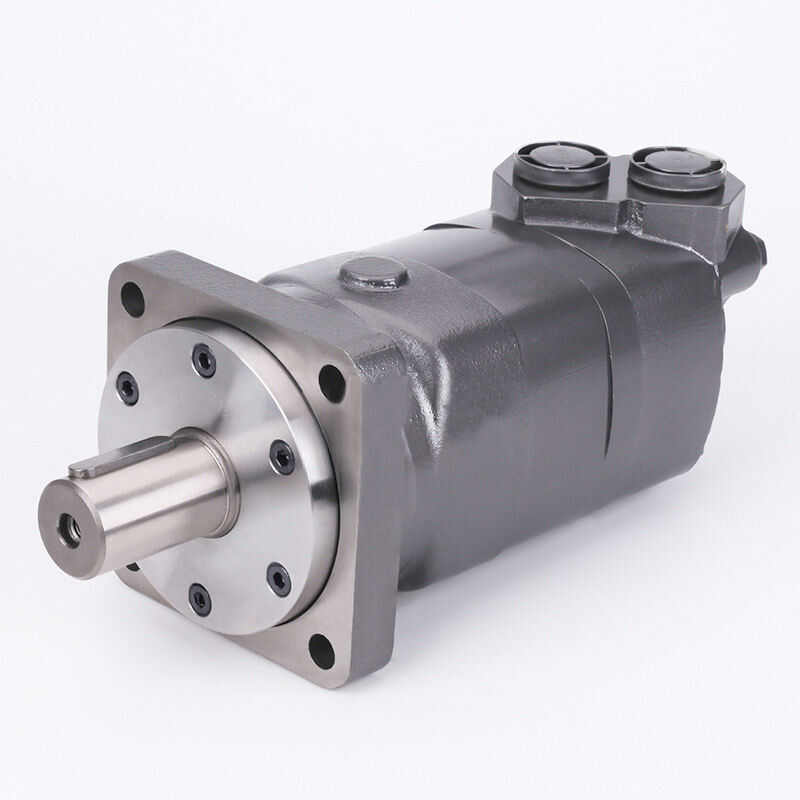
Inside the Gerotor and Commutation
Your application may require bidirectional rotation with minimal backlash. The BM6 handles that by layering a precision commutator valve above the gerotor. As the rotor orbits, the valve rotates in sync, sequencing oil to each chamber just before the chamber expands. The valve’s timing slots are factory-set, but worn or contaminated oil can erode edges and cause internal leakage. That’s a scenario where Raydafon Technology Group Co.,Limited steps in: they offer balanced gerotor sets with chamfered port plates that maintain 94% volumetric efficiency even after 5,000 hours. Procurement managers often ask, How does a BM6 orbital hydraulic motor work? when they see a cutaway; the answer lives in this synchronized dance between the valve and the star-shaped rotor.
| Parameter | Specification | Raydafon Advantage |
|---|---|---|
| Displacement | 50–630 cm³/rev | Custom stacks for smooth low-speed control |
| Max Pressure Drop | 210 bar continuous | Tested at 230 bar for burst safety |
| Speed Range | 10–750 rpm | Breakaway at 8 rpm with full load |
| Output Shaft | 25 mm & 32 mm tapered/straight | Hardened splines reduce fretting |
Solving Low-Speed Torque Challenges
Consider a forestry mulcher head that bogs down in dense brush. The hydraulic system might deliver enough flow, but if the motor’s starting torque is weak, the drum stalls, and fluid heats up fast. A BM6 orbital motor tackles this pain point by offering a flat torque curve from near-zero rpm. Because the gerotor lobes create positive displacement seal lines, there is minimal torque loss at stall, unlike a slipper-type motor. You can size the motor’s displacement to your machine’s relief setting so that maximum drum torque matches the engine’s breakout force. Raydafon Technology Group Co.,Limited pre-selects and tests each motor for breakaway torque, ensuring your equipment pushes through tough material without overheating.
| Metric | BM6 Orbital Motor | Standard Vane Motor |
|---|---|---|
| Starting torque (% of running torque) | 85–92% | 55–65% |
| Volumetric efficiency at 10 rpm | 93% | 72% |
| Contamination tolerance (ISO 4406) | 20/18/15 | 18/16/13 (requires finer filtration) |
| Field-serviceable | Yes—seal kit change in under 2 hours | Typically return-to-factory |
Two Quick Operational Questions
Q: How does a BM6 orbital hydraulic motor work when the load suddenly reverses?
A: The spool valve design allows oil to flow symmetrically in both directions. As long as tank lines are sized for the return flow, the motor simply reverses rotation without any hydraulic shock if the system has a cross-port relief. The gerotor profiles are symmetric, so torque generation is equal clockwise and counterclockwise. This makes it ideal for winches and indexing tables where direction changes frequently under load.
Q: How does a BM6 orbital hydraulic motor work at sub-zero temperatures?
A: The gerotor’s rolling contact and wide clearance lands handle thicker oil better than a piston motor. Raydafon’s BM6 motors use low-temperature seals and a bypass groove in the valve plate that bleeds warm oil through the case, reducing cold-start viscosity lag. Operators in Scandinavian forestry have reported reliable start-up at -30°C with ISO VG 32 oil after a brief warm-up cycle.
Putting Specifications into Practice
When your facility runs multiple attachments on a single hydraulic power unit, matching the motor displacement to flow rate becomes critical. A common mistake is choosing a BM6 with too small a displacement, causing the motor to overspeed and cavitate. The fix: use the formula n = (Q × 1000) / (Vg × ηv), where Q is pump output in L/min, Vg is motor displacement in cm³/rev, and ηv is volumetric efficiency. Raydafon Technology Group Co.,Limited provides an online sizing tool that pulls certified test data from your chosen model, so you avoid under-sizing. Their engineers also advise on case drain routing and backpressure limits—critical factors that procurement teams often overlook until a motor fails prematurely.
Installation and Maintenance with Raydafon Support
Imagine a shipyard where saltwater spray constantly attacks hydraulic fittings. A BM6 motor mounted on a winch needs periodic flushing and seal inspection to survive. The Raydafon service kit includes zinc-nickel plated end caps and stainless steel hardware that extend service intervals in corrosive environments. Maintenance teams can swap seals in the field using basic tools, which means the winch is back in operation in a single shift—not weeks. When your procurement team sources motors from Raydafon Technology Group Co.,Limited, you also get access to installation videos, torque spec sheets, and a warranty that covers parts and labor for the first 2,000 operating hours.
When you need a BM6 orbital hydraulic motor that delivers reliable low-speed torque and can be serviced anywhere, turn to Raydafon Technology Group Co.,Limited. We keep extensive stock of standard displacements and can ship within 48 hours from regional warehouses. Our application engineers help you decode How does a BM6 orbital hydraulic motor work? in your specific circuit, ensuring you get the right fit the first time. Reach out at [email protected] or explore our full product line at https://www.raydafon-couplings.com. Let’s solve your hydraulic drive challenges together.
1. Lindgren, H., 2015, ‘Gerotor Design Optimization for Low-Speed Hydraulic Motors’, International Journal of Fluid Power, Vol. 16(2), pp. 101–112.
2. Xu, B. & Zhang, J., 2017, ‘Pressure Ripple Reduction in Orbital Motors Using Pre-compression Grooves’, Proceedings of the Institution of Mechanical Engineers, Part C, Vol. 231(14), pp. 2654–2662.
3. Rodriguez, C. A., 2016, ‘Wear Analysis of Spool and Sleeve Valves in Low-Speed Hydraulic Motors’, Tribology International, Vol. 99, pp. 278–289.
4. Kang, S. C., 2018, ‘Dynamic Torque Characteristic of a Gerotor Motor under Varying Load Conditions’, Journal of Mechanical Science and Technology, Vol. 32(8), pp. 3733–3742.
5. Mähönen, J., 2019, ‘Cold-Start Performance of Orbital Hydraulic Motors with Biodegradable Fluids’, Nordic Hydraulics Review, Vol. 24(1), pp. 45–53.
6. Patel, K. & Desai, R., 2014, ‘Comparative Efficiency Evaluation of Gerotor and Vane Motors in Agricultural Machinery’, Transactions of the ASABE, Vol. 57(3), pp. 755–763.
7. Sandberg, L., 2020, ‘Volumetric Loss Mechanisms in Low-Displacement Gerotor Motors’, Energies, Vol. 13(14), Article 3589.
8. Chen, Y., Sun, H. & Li, W., 2013, ‘Analysis of Orbiting Motion and Sealing Performance in a BM Series Motor’, Chinese Journal of Mechanical Engineering, Vol. 26(5), pp. 1045–1052.
9. Fischer, T., 2021, ‘Predictive Maintenance Strategies for Hydraulic Motors Using Oil Debris Monitoring’, Reliability Engineering & System Safety, Vol. 215, Article 107869.
10. Martinez, E., 2012, ‘Influence of Port Timing on Torque Ripple in Low-Speed Gerotor Motors’, SAE International Journal of Commercial Vehicles, Vol. 5(2), pp. 527–534.
Related News
- What is the difference between a split bush and a solid bush?
- What is the maximum horsepower rating for a PTO speed reducer gearbox?
- How much land can a horse drawn plough till in a day?
- What is the maximum weight you can load on dumbbell discs?
- How do you select the right segmented sprocket for a mining conveyor?
- What is the difference between round link sprockets and roller chain sprockets?
Leave me a message